A Late-Autumn Walk Through the Coastal Garden
A late-autumn walk through the coastal garden reveals seed heads, leaf colour and lasting structure, helping you read the season without turning it into a task list.

The common mistake on a late-autumn walk through the coastal garden is to look only for what has finished: browned leaves, spent flowers and empty beds. That narrow view costs you the season’s quieter detail, from seed heads holding their shape in salt air to the lines that still give a border its form.
Instead, take a short route and let it unfold over a week. You are not checking off jobs or deciding what must be cut back. You are watching how the garden changes, and letting one visit inform the next.
Begin at the garden’s most exposed edge
Choose a starting point where the weather is easiest to read: perhaps a low wall above the beach, a windward fence, or the open end of a path. Pause long enough to notice which stems bow, which stand upright and where fine sand has gathered around their bases. The aim is not to diagnose damage, but to see how exposure is shaping the season’s appearance.
Look for persistent seed heads on plants such as sea holly, teasel or ornamental grasses, if these grow in your garden. Their silhouettes can remain legible after petals and leaves have gone. A pale stem against a dark hedge may draw the eye more strongly than a bright summer flower did.
Walk the same stretch again a day or two later, ideally after a change in weather. A damp morning can darken stems and bring out their outlines; a brisk, dry day may set them moving. The route stays the same, but the garden does not.
Follow leaf colour rather than the path
On the next visit, let changing leaves lead you away from the obvious route. In coastal gardens, wind and salt can make colour uneven: one side of a shrub may fade early while the sheltered interior holds green. Look at individual branches, not only the plant as a whole.
Notice where colour gathers. Leaves caught against a stone wall can look warmer than the same leaves against open sky. A small patch of copper or yellow may mark a sheltered pocket, while nearby foliage has already thinned. These differences are part of the garden’s seasonal character, not signs that every plant is following a single timetable.
Imagine a path-side shrub whose outer leaves have turned ochre while its inner branches remain green. On one visit, you might note where the colour begins; after several days of wind, you could return to find the outer leaves scattered beneath it, making the shrub’s outline easier to see. The useful observation is the change between visits, not a judgement about whether the shrub looks tidy.
Notice what still gives the garden its shape
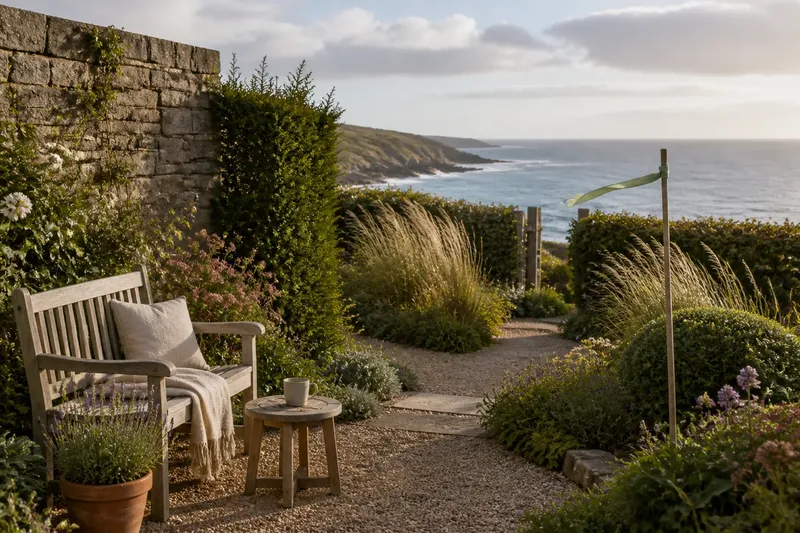
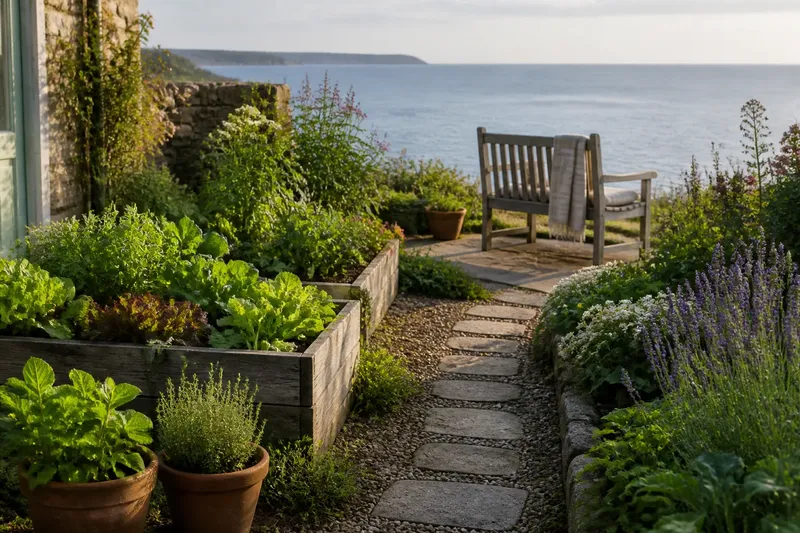
As foliage thins, look beyond flowers and leaves to the forms that remain: a clipped hedge, a drift of grasses, a low bank, a weathered bench or the curve of a path. These elements become more visible when summer growth recedes. Think of a garden border as a loosely woven basket: flowers are the bright strands, but the underlying weave is what keeps the shape readable.
Pause at a point from which you can see more than one part of the garden. Notice whether the route is still clear to the eye, where a tall plant interrupts the view, and which persistent stems create a pleasing rhythm. A garden need not look full to feel composed; a repeated line or a well-placed evergreen can carry the scene through a quieter month.
Pay attention to how the coastal setting frames these forms. A hedge can sit against a wide band of grey sea, while grass heads mark the foreground. On a still day, the view may seem open; in gusty weather, moving stems bring the space back into focus.
Let weather set the pace of the walk
Spread the route across a week, choosing a different kind of attention each time: seed heads at the exposed edge, leaf colour along the path, then the garden’s underlying structure. If rain or strong wind makes the walk unpleasant, postpone it. A view from a doorway or window can still show whether stems are moving, leaves are falling or the light has shifted.
Keep the walk unhurried, but do not force yourself to cover every corner. A short loop that you can repeat is more revealing than a hurried circuit. If a particular plant catches your eye, stop there and watch how its outline changes before moving on.
There is no need to carry tools. A small notebook can help if you want to remember where colour held or which stems remained upright, but a mental note is enough. The point is to see the garden as it is now, rather than convert every observation into a task.
What should you look for on a late-autumn walk?
Which seed heads are worth noticing?
Look for heads that hold a distinct outline, catch the light or move visibly in the breeze. Their value on this walk is visual and seasonal; you do not need to decide immediately whether they should stay.
Why does leaf colour vary across one plant?
Exposure, shelter and the amount of light reaching different branches can make colour appear uneven. Compare the outer and inner foliage, then revisit the same plant after a change in weather.
What if the garden looks bare?
Shift your attention from flowers to boundaries, path lines, stems and evergreen shapes. A garden can still have a clear composition when much of its foliage has fallen.
Should the walk include pruning or clearing?
Keep this particular walk separate from maintenance so observation does not become a rush to tidy. If you later decide to prune or remove a plant, follow its care label or the maker’s instructions where relevant, and check local rules when they apply.
End by choosing one place to revisit
Before you leave, choose a single view to return to: the seed heads against the fence, a patch of changing leaves, or the line of the path beneath thinning branches. On the final visit of the week, stand in the same place and notice what has shifted. That small comparison is often enough to make the late-autumn walk through the coastal garden feel complete without turning it into a list of unfinished work.
Keep the chosen view in mind as the season advances. It may change again after a storm or a spell of calm, offering a quiet record of the garden’s own pace.