From Kitchen Garden to Sea View: The Changing Coastal Plot
A coastal garden can serve food, rest and a sea view without losing its usefulness; choose a layout that fits how you want to spend time outdoors.
The common mistake in a coastal garden is to treat the sea view as the only purpose worth planning for. A plot arranged solely to frame the horizon can leave you with an exposed, awkward space that offers little reason to use it; one devoted entirely to crops may conceal the very prospect that drew you outside. The changing coastal plot is best understood as a set of choices about what the garden should do now, and what it may need to do later.
Older coastal gardens often made room for practical needs: vegetables, herbs, fruit and a sheltered place to work. As household routines and expectations changed, some plots gave more space to sitting, entertaining and looking out to sea. That shift need not mean choosing between productive ground and ornament. It means deciding which purpose should lead, which can share space, and which can wait.
Let the garden’s present purpose lead
Begin with an ordinary week rather than an idealised summer afternoon. Notice where you already sit, where tools accumulate, whether you cook with fresh herbs, and which parts of the garden you pass through without stopping. Those habits reveal more than a sketch of a grand terrace or a full run of vegetable beds.
Then name the garden’s main job in a sentence: “This is where I grow food,” “This is where I sit with a view,” or “This must do both.” The sentence is not a permanent rule. It is a way to prevent every new idea from claiming the same patch of ground.
- Choose utility first if you regularly grow or gather food and enjoy tending it. Keep the most-used beds close to the kitchen door or a convenient route, so harvesting remains part of daily life rather than a separate expedition.
- Choose a sitting garden first if outdoor meals, reading or quiet observation matter more than regular harvesting. Give the seating a comfortable relationship to the house and view, then reserve a modest, useful growing area rather than retaining beds from habit.
- Choose a shared garden if both activities matter and neither is used every day. Arrange distinct zones with a clear route between them, so working beds do not become the threshold to every chair.
A useful layout behaves like a well-used kitchen table: it can support more than one task, but the things needed most often should be within easy reach. A pot of mint beside the sitting area may be more useful than a large herb bed placed out of the way.
Keep the productive plot if it earns its place
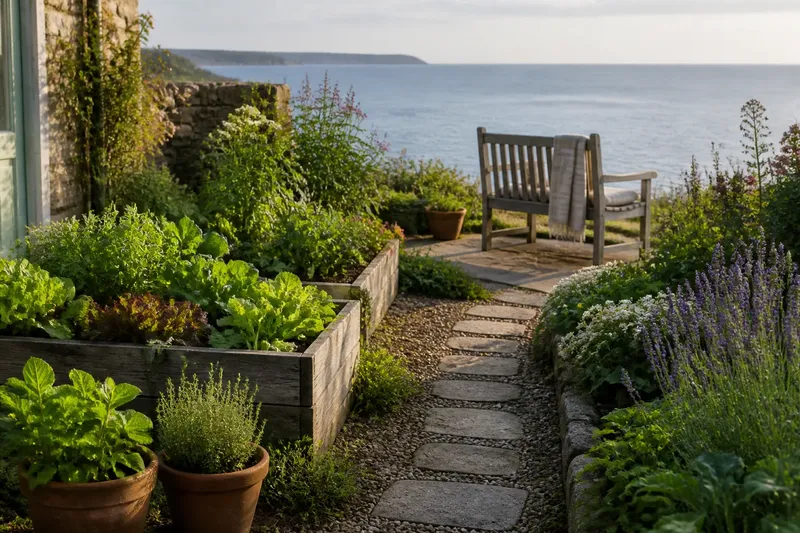
A kitchen garden remains a good fit when you value the work as well as the harvest. Raised or edged beds can make a recognisable working area, while paths let you reach crops without stepping on the growing soil. In a coastal setting, the layout should also make routine care manageable when wind, salt and dry spells demand attention.
Do not preserve every bed simply because it was once productive. A bed that is difficult to reach, poorly placed for water, or repeatedly left unplanted may be asking for a different use. Convert one neglected area at a time, keeping the most convenient beds for the crops you genuinely use.
Say you have a narrow plot behind a cottage, with two old vegetable beds and a small bench facing the water. You cook with herbs but rarely harvest bulky crops. Keeping one bed for herbs and salad leaves, reshaping the other as a planted edge, and turning the bench towards the view would make the garden serve both habits without pretending you have time for a larger kitchen garden.
Productivity can also be seasonal. A bed used for vegetables in warmer months might carry a compact perennial crop or remain visibly tended through quieter periods. The point is not to keep soil occupied at all costs, but to give each part of the plot a purpose that suits your routine and local conditions.
Give the sea view a place without surrendering the plot
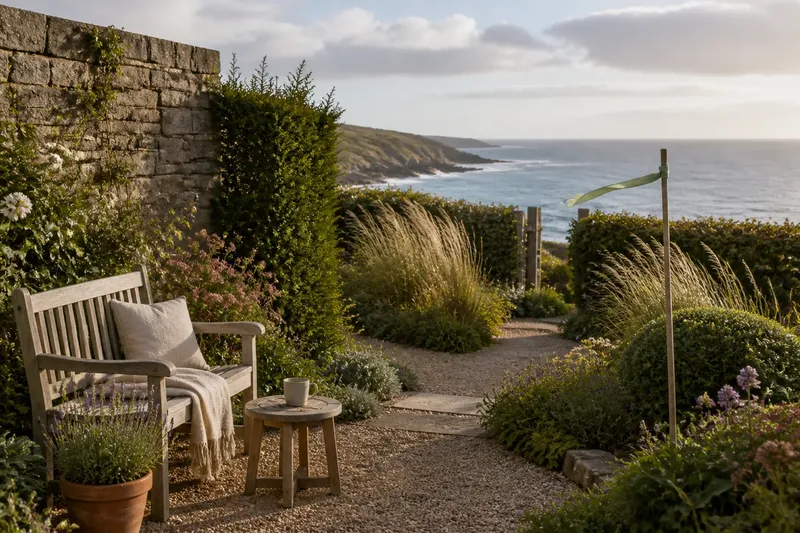
If the outlook is the reason you go outside, make a sitting place from which it can be enjoyed comfortably. A view is not only a line across the garden: it depends on where you sit, what interrupts your gaze, and whether the spot feels usable on an ordinary day. Check the prospect from seated height as well as from the house.
Keep the immediate foreground calm enough for the horizon to register. A low planting edge, a simple seat or an open patch of ground may be sufficient; busy borders and tall features can compete with the distant view. This does not mean removing all planting. Instead, place taller plants where they provide a useful frame or privacy without closing the view you want to keep.
For a narrow coastal plot, a seat at the far end can make the garden feel like a destination, but only if the route there is pleasant and accessible. If the end of the garden is exposed or rarely reached, a smaller sitting spot nearer the house may serve better. Let actual use decide where the view is enjoyed, rather than assuming the farthest point is automatically the best.
Share space when the plot has competing demands
Many gardens do not need a complete change from food production to leisure. They need a clearer division of labour. A compact growing zone can sit beside an open sitting area, while a path connects the two without making either feel like leftover space.
Choose boundaries that suit the garden’s scale. Low edging, a change in paving, or a gap between beds can define a working area without building a visual wall. In an exposed plot, an overly formal division may make the garden feel smaller and leave the sitting place disconnected from the rest of the ground.
Where children, guests or pets use the garden, allow the shared space to do more than one thing. An open area can accommodate a chair, a small table or play, while a nearby bed supplies herbs or cut flowers. Keep fragile or frequently tended crops out of the main route, so ordinary movement does not turn into a source of friction.
Think about maintenance as part of the layout, not an afterthought. A garden that asks for attention in several distant corners can become tiring, especially when coastal weather makes visits less comfortable. Grouping related tasks—watering, harvesting and checking containers, for example—can make a mixed-purpose plot easier to keep in use.
Which layout fits the way you use the garden?
Should I keep an old vegetable bed?
Keep it if you use its crops and can reach it comfortably. If it stays empty or difficult to tend, reduce the growing area or give that section another clear purpose.
Where should a sea-view seat go?
Place it where you can reach it easily and enjoy the outlook from a comfortable position. A sheltered spot near the house may be more useful than an exposed seat at the plot’s far edge.
Can a small coastal garden grow food and offer a view?
Yes, if you concentrate crops in a practical area and keep the main sightline open. Herbs and compact crops near a route or sitting place can preserve usefulness without filling the whole view with beds.
How should I choose between a lawn and more beds?
Keep open ground if you use it for sitting, play or moving through the garden. If it is rarely used, consider a smaller open area and give the rest a more purposeful role, such as planting or a compact growing bed.
Allow the garden’s purpose to change again
A coastal plot is not a choice made once and left alone. A household may stop growing vegetables, begin eating outdoors more often, or find that a once-comfortable route has become inconvenient. Review the garden by noticing what is used, what is avoided and what takes effort without giving much back.
Make changes in manageable pieces. Move a seat before rebuilding a whole terrace; reduce a bed before removing every productive area. For a coastal garden, this gradual approach keeps the sea view, food growing and everyday comfort in conversation with one another. The best layout is the one that makes the garden worth stepping into for the life you lead now, while leaving room for that life to change.