Gravel or Shell for a Coastal Garden Path?
Gravel or shell for a coastal garden path? Compare colour, feel and sound to choose a surface that suits the route, its users and the garden’s mood.
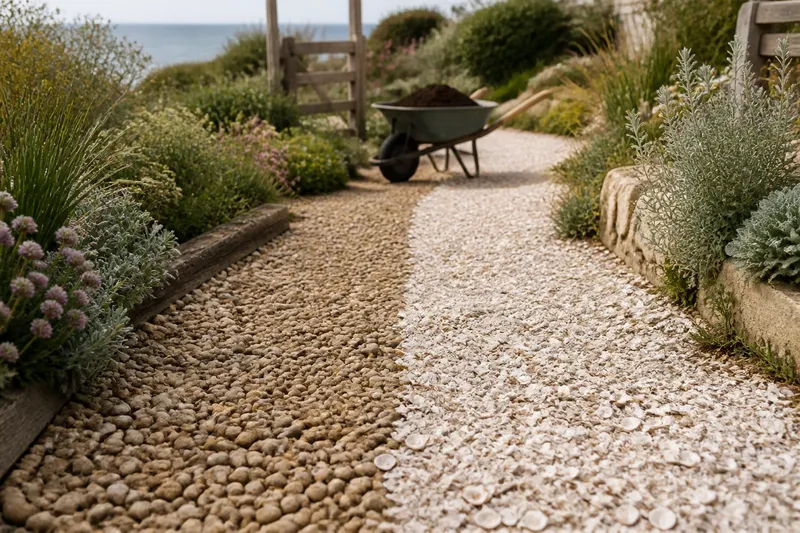
The common mistake with a coastal garden path is choosing gravel or shell from a handful in a display tray, then discovering that the surface feels wrong underfoot or jars with the planting. A path is encountered in motion: in bare feet, with a wheelbarrow, after rain and in the changing light. Gravel or shell should be chosen for the walk it invites as much as for its colour.
What is the difference between gravel and shell on a garden path?
Gravel gives a path a mineral, grounded character; shell brings a paler, more reflective surface with a distinct coastal association. Both can be loose-laid, but their appearance, sound and feel vary with the material’s grade, shape, colour and how firmly it settles.
“Gravel” covers stones from different sources and in different forms. Rounded pebbles can shift and roll underfoot, while angular stone has more edges to interlock. Shell paths may use crushed or broken shell, often with a mix of sizes. The shell’s natural tones can range from warm cream to grey, and fragments may catch the light differently from stone.
Neither name tells you exactly how a surface will behave. Look at the actual material, not only a photograph or the label on a sample. A small tray reveals colour and texture, but a larger patch is more useful for judging how the pieces sit together.
Which surface feels better underfoot?
Gravel can feel firm when the stones are angular and settled, or lively and unstable when they are rounded or loosely spread. Shell may feel crisp and uneven beneath a thin sole, particularly where larger fragments remain at the surface. The most comfortable choice depends on how the path is used and what footwear is usual in the garden.
For a route used in sandals or bare feet, smoothness matters more than a general preference for one material. Examine the surface for sharp edges, large pieces and spots that might shift. A garden path is not a beach: a texture that is pleasant to look at may be tiring to walk across repeatedly.
For a wheelbarrow, mobility aid or garden trolley, the ability to roll matters. Loose, rounded stones can move beneath a wheel; a more compacted material may offer steadier passage. Imagine a gardener carrying compost from a gate to a raised bed: if the path needs to take a loaded barrow, a stable, level surface is likely to be more useful than a loose decorative one. A short trial patch can make that difference apparent before the route is laid.
How do gravel and shell change the look of a coastal garden?
Gravel tends to read as a quiet, continuous ground plane. A grey or buff stone can sit alongside weathered timber, grasses and muted foliage without calling much attention to itself. Darker gravel can sharpen the outline of pale plants, though it may also make a narrow route feel visually heavier.
Shell has a more specific voice. Its light surface can echo bleached stems, pale stone or the bright edge of a shore, and it may give a small path a clear presence among low planting. That brightness can be welcome in a shaded corner, but a broad expanse may dominate a planting scheme that depends on subtle greens and soft colours.
Think of the route as a ribbon laid through the garden. Like choosing a frame for a picture, the decision is not simply which material is attractive on its own; it is whether the edge and colour help the surrounding planting make sense. Compare samples beside the plants, paving and edging that will sit next to them.
Which surface suits a quiet garden and which suits a lively one?
Gravel often supports a restrained, naturalistic mood, especially when its colour relates to local stone or the sandy ground nearby. Shell can make a path feel more explicitly maritime and informal. Neither material dictates the garden’s style, but each sets an expectation before a visitor notices individual plants.
Sound is part of that impression. Gravel often crunches; shell can produce a lighter, crisp rustle, though the result varies with fragment size and how the surface is laid. If a path runs close to a seat or a bedroom window, listen to a sample being walked on rather than assuming the sound will be negligible.
For a route used by children or visitors moving in a group, consider whether the surface’s noise and movement are welcome. A lively crunch can make arrival feel intentional, while a softer, more settled path may suit a contemplative corner. The decision is about the atmosphere people will encounter, not a rule that one material belongs to a particular garden style.
What should you consider before choosing a path surface?
Start with the path’s job, then compare materials in the place they will be seen. A route to a greenhouse has different demands from a short stroll between a bench and a border. Before settling on gravel or shell, consider:
- Route and frequency: Is this a main passage or an occasional garden walk? More frequent use calls for a surface that remains comfortable and legible as feet cross it.
- Wheels and loads: Will a barrow, trolley or mobility aid use the route? Check how the material behaves under a wheel, not just under a shoe.
- Edges: Are there firm borders to hold the loose surface in place? Timber, stone or metal edging can give a path a clearer boundary, provided it suits the garden.
- Colour beside planting: Does the sample sit comfortably with foliage, flowers, walls and nearby paving in both sun and shade?
- Sound and texture: Does the crunch or rustle suit the path’s setting, and is the surface pleasant for the people who will use it?
- Material origin and composition: Is the product what its description implies, and is it suitable for the intended use? Where a product label, manufacturer instructions or local rules determine suitability, follow that guidance.
These checks are more useful than choosing by colour alone. They turn a broad preference into a decision about a particular route and its surroundings.
Can you compare samples without committing to a whole path?
Yes. Put a small amount of each candidate on the ground where the path is planned, keeping the samples separate and contained. View them in different light, step across them in the footwear commonly used in the garden, and roll a barrow over them if that is relevant.
A sample beside a nursery pot may look convincing but appear much brighter against a dark hedge. Likewise, a surface can seem quiet in a handful and become noticeably noisy under repeated footfall. For a coastal plot, look at the material against the plants and hard surfaces already present rather than against an isolated colour card.
Say you are choosing a route from a cottage door to a sheltered seat, with low grasses along one edge. Imagine placing a pale shell sample beside the grasses and a buff gravel sample in the same spot, then walking both in ordinary shoes. If the shell overwhelms the planting while the gravel sits quietly, the expected visual result points towards gravel; if the path needs a brighter presence and the shell feels comfortable, the balance may favour shell. This is an invented comparison, not a report of a real garden.
Which material is easier to keep looking composed?
Neither loose surface stays visually unchanged without attention. Leaves, blown sand and plant debris can settle into gaps, and foot traffic can move material from the centre towards the edges. The colour and particle size affect how conspicuous that disturbance appears.
On a pale shell path, dark leaves and soil may stand out; on mixed gravel, small debris can blend in or lodge between stones. A leaf rake or hand brush can help clear loose material, but use a light touch so the path itself is not dragged aside. Keep edges visible and remove encroaching growth before it makes the route feel narrower.
Coastal wind can deposit sand over a path as well as carry light debris across it. If the surrounding garden is sandy or exposed, observe where material naturally collects before choosing a very pale or finely textured surface. The pattern of drifting sand may matter more than the nominal difference between shell and stone.
Does shell or gravel suit every coastal garden?
No. Coastal gardens differ in exposure, planting, soil and the way people move through them, so a surface that belongs in one plot can look misplaced in another. Shell’s maritime character may feel at home near salt-tolerant planting and weathered materials, but it can read as decorative if the rest of the garden is deliberately spare. Gravel is adaptable, yet a colour or texture that clashes with nearby stone can make a path appear disconnected.
Also consider the route’s relationship to the house. A path seen from a kitchen window becomes part of the garden’s composition even when nobody is walking on it. A practical route through working beds may benefit from visual restraint, while a short approach to a sitting place can carry more character.
Choosing gravel or shell for a coastal garden path is ultimately a choice about the experience of crossing a particular piece of ground. Compare the materials where they will lie, judge them with the people and tools that will use the route, and let the planting remain visible around them. A good surface does not need to announce itself; it needs to make the walk feel at home in the garden.