The Bare-Ground Shortcut: Why a Border Needs More Than Flowers
A coastal border needs more than flowers: use foliage, stems and open ground to create interest before bloom, after it fades and through changing weather.
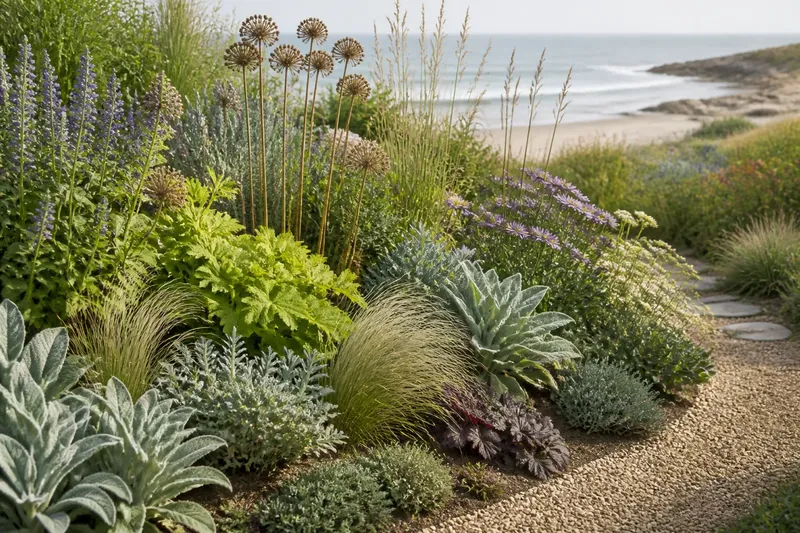
The common mistake in a coastal border is to choose plants by their flowers and leave the ground between them to chance. The cost is a brief, crowded display followed by bare soil, fading stalks and gaps that seem to call for more plants. A border needs more than flowers: foliage, stems and deliberately open space give it a shape that lasts beyond peak bloom.
That does not mean every patch must be filled or every plant kept standing. The useful question is what each part of the planting contributes across the season: a leaf shape, a change in texture, a visible stem, or room for another plant to emerge. Once those contributions are considered alongside flowers, choosing plants becomes less like collecting colours and more like composing a scene.
A border is read through more than its blooms
Flowers are the most obvious signal in a planting, but they are not the only features a person sees. A silvery leaf catches light on a cloudy day; a fine grass makes a soft edge against a path; upright stems give a low mound a clear outline. These details often remain visible when flowers are scarce or spent.
In a coastal garden, foliage earns particular attention because wind can alter the look of a border from one day to the next. Broad leaves may turn or show their paler undersides, while narrow leaves move as a group. Salt-laden air and exposed conditions also make plant choice site-specific: a leaf that is handsome in a sheltered corner may not suit an exposed bed. Check the plant’s stated conditions and observe how your own site behaves before relying on a particular feature.
Think of a border as a table setting rather than a vase of cut flowers. Blooms are the bright dish, but the plain plate, the space around it and the shape of the cutlery make the arrangement legible. In a planting, foliage and stems do similar quiet work, while open ground gives each feature room to register.
Foliage carries the planting between flower seasons
Leaf form is a practical starting point when a border looks thin outside its main flowering period. Compare the shapes already present: rounded leaves beside narrow blades, finely divided foliage beside broad, simple leaves. A few clear contrasts can make a small planting feel considered without adding a succession of unrelated flowers.
Colour matters, but it need not mean constant brightness. Grey-green and silver foliage can sit calmly beside darker greens, while a bronzed or purple leaf can provide a deeper note. In strong coastal light, pale leaves may appear almost luminous; in shade or dull weather, the same plant can read more quietly. Look at foliage at the time of day you use the garden, not only in a nursery display.
Texture is another way to distinguish plants. A coarse, substantial leaf can anchor a group of finer foliage, while a softly hairy surface gives a different impression from a glossy one. Avoid assembling every contrast in one small patch. Repeating a leaf shape or colour elsewhere in the border helps the planting feel connected rather than like a row of individual specimens.
Say you have a sunny bed where flowering perennials leave a visible gap after their first flush. You could add a low, spreading plant with foliage suited to the site, placing it where it softens the soil line without crowding the existing crowns. The expected observable result is a more continuous layer of leaves through the gap, while the flowering plants remain visible above it.
Stems give the border a shape after flowers fade
Stems and seed heads can hold a plant’s outline after its petals have gone. Their value is not simply that they remain standing: a thin, branching stem gives a different pattern from a firm upright one, and a rounded seed head differs from a narrow spike. These forms can create a quiet rhythm across the bed when repeated with restraint.
Leaving some spent stems also lets the border change gradually rather than switching from flower to cut-back ground all at once. Choose which plants have useful structure and which have become untidy or are shading neighbours. There is no need to preserve every stalk. Selective cutting keeps the planting readable while allowing the more durable forms to remain for a while.
Coastal exposure makes this choice especially visible. A tall, delicate stem may bend or lean, and that movement can suit the planting if it does not smother nearby plants or obstruct a path. A strong framework of lower foliage can help the scene feel grounded, while scattered upright forms provide height. The aim is not to force every plant into a rigid shape, but to decide what kind of movement belongs in that part of the border.
Open space is part of the planting
Empty ground is not automatically a flaw. A deliberate gap can set off a mound of foliage, show the curve of a path or make a group of stems easier to see. The difference between useful openness and an unfinished patch is often whether the space has a clear edge and a reason to remain.
Consider where a gap sits. A narrow strip beside paving may read as an untended margin, while a small pocket among established plants can offer contrast and room for seasonal growth. If the soil is exposed to coastal wind, leaving it bare may also invite erosion or rapid drying, so openness should be balanced with a suitable low plant, a mulch appropriate to the bed, or another considered surface treatment. The right choice depends on the conditions and the plants around it.
Spacing should account for how plants look at different stages, not just how they appear in a pot. A young plant may seem lost in a gap that will later be occupied by its leaves, while a vigorous neighbour may close a space more quickly than expected. Arrange plants with their mature form in mind and leave enough room for air and access. The border should feel composed now without being packed so tightly that its shapes disappear later.
How do foliage, stems and gaps work together?
Which plants should provide the main foliage?
Choose plants whose leaves suit the light, soil and exposure of the particular bed, then use them to establish its broad shapes. A handful of recurring leaf types usually gives more coherence than many unrelated foliage plants competing for attention.
Should spent stems be left in place?
Keep stems that contribute a clear outline or movement, and remove those that collapse, obscure other plants or make the border look neglected. The decision can differ from one plant to the next, even within the same bed.
How much open ground should a border have?
There is no fixed proportion: judge whether the gaps frame plants or simply interrupt them. Check the bed from its usual viewing points and consider how the open patches will change as plants grow or die back.
How can a border look settled before flowers open?
Use foliage shapes, repeated colours and visible stems to give the planting a recognisable structure outside its flowering period. A clear path edge and a few deliberate gaps can make that structure easier to read.
Plan the border as a changing arrangement
A useful way to review a planting is to look at it in more than one season and from more than one position. From a doorway, you may notice the overall bands of foliage; from the path, you may see that a tall plant hides a lower one. A quick sketch can record these observations without turning the border into a rigid plan.
For each plant, note the role it has beyond its flowers: broad leaf mass, fine texture, ground cover, upright stem or a temporary open space. If two plants do the same job in the same place, one may be unnecessary. If a section offers only a burst of bloom followed by bare ground, consider whether a foliage plant or a better-spaced group would make the transition more graceful.
Do not confuse variety with constant novelty. Repeated forms help the eye move through a border, and the occasional different leaf or stem becomes more noticeable because it is not everywhere. In a coastal setting, this restraint also leaves room for natural movement: leaves turn, grasses sway, and the outlines of plants shift with the weather.
A border that relies on flowers alone can still have a fine moment, but it asks that moment to carry the whole year. A better-planned coastal border gives each plant a job that remains visible when petals are absent: foliage to hold the ground, stems to preserve a line, and open space to let both be seen. When choosing plants for a border, look beyond the bloom and ask what the plant will contribute before it opens and after it fades.